
Why a half-hearted TopLeft trial gets half the results
· Wim Kerkhoff · Service Management

How MSPs mistake “trying” for transforming, and why partial implementation delivers no benefits despite being low risk
The Challenge: When “Testing the Waters” Keeps You Stuck
Picture this: You’re watching competitors improve their project management and service delivery with TopLeft.
Their results?
-
Project completion times: Cut in half
-
SLA compliance: Jumped from 60% to 90%
-
EBITDA margins: An impressive 20-25%
So, you decide to test it. You get your project managers using Kanban boards. You set up visual workflows. But, you hold back on rolling it out to the technicians & engineers working tickets….
Fast forward six months…

You’re back to spreadsheets. Back to firefighting service tickets. Back to wondering why TopLeft “didn’t work” while your competitors keep improving their workflow efficiency and team coordination.
Here’s what Wim Kerkhoff, TopLeft’s founder, sees repeatedly:
“Success is 10% the tool, and 90% about the mindset and methods and change adoption”
The hard truth? You’re not even beginning the transformation. When you only “try” TopLeft, implementing the tool without the complete system of mindset, methodology, and habits, you guarantee zero improvement in your service and project management delivery.
The result:
-
Your operational maturity level stays low
-
Your team drifts back to old task management methods, such as working from email, a Notepad document, their calendar, or Teams messages…
-
Managers and coordinators keep wasting time nagging people for ticket updates and playing the Tetris game in calendars and Excel
The Opportunity: Build a System That Compounds Your Success
While most MSPs operate at 5-10% EBITDA margins, the top performers achieve 20-25%+ through superior workflow management and visual optimization.
What’s their differentiator? They don’t just use TopLeft. They implement the complete system of mindset, methodology, and habits. They are thinking about about things like pull-based workflow, removing blockers on tickets, unblocking the bottleneck engineers, and daily huddles (10 to 15 minute meetings at the board).
Watch what happens when you commit fully:
-
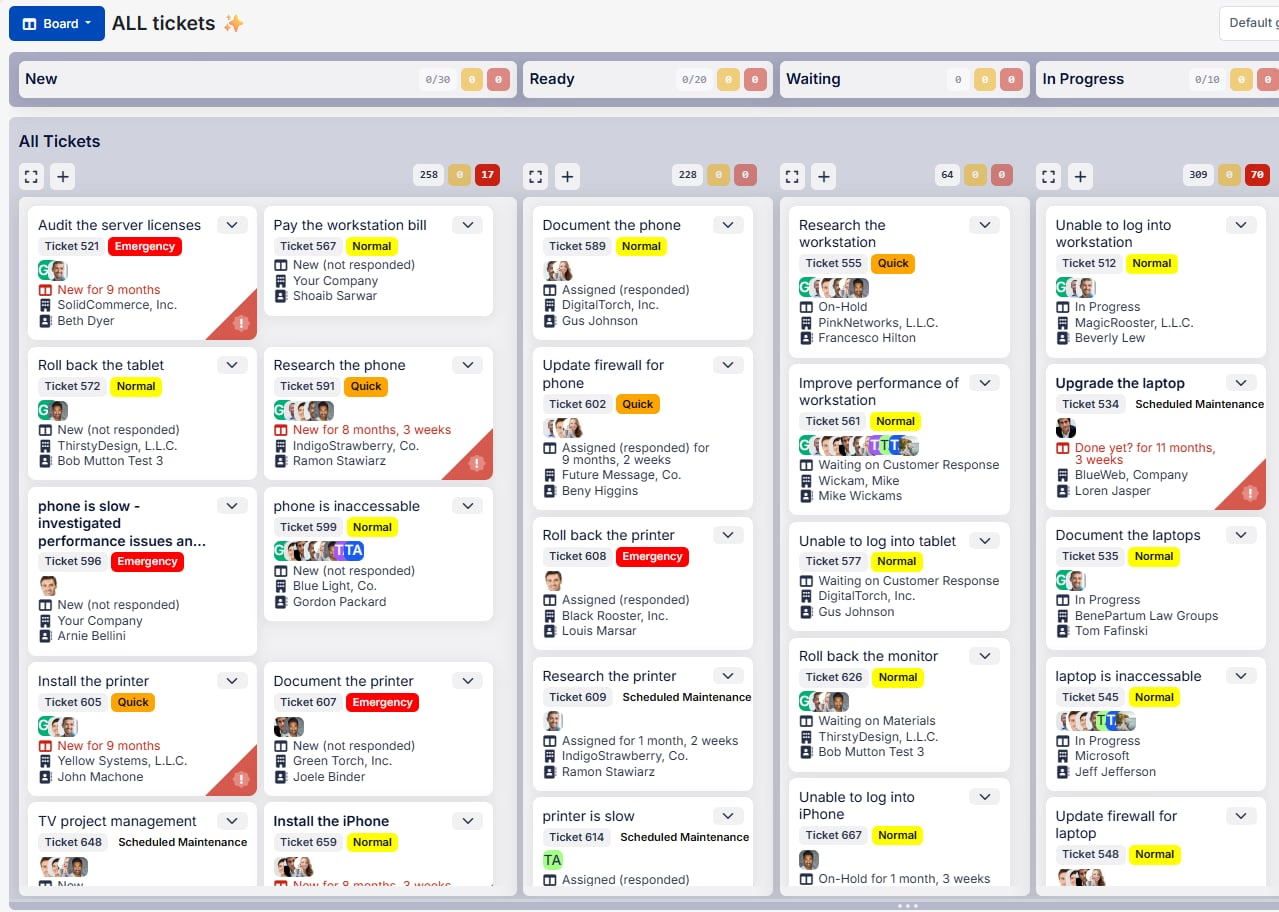
Technicians pull work from the same Kanban boards as PMs: Everyone works from unified priorities
-
Managers see real-time flow instead of outdated scheduling: Decisions accelerate, bottlenecks clear faster
-
Daily huddles shrink from 30 minutes to 10: Visual boards make priorities and blockages instantly clear
-
Every week gets better than the last: Continuous improvement becomes your competitive advantage
The goal is operational efficiency built on systematic habits that compound weekly. When your entire team, especially technicians handling service tickets, operates from the same visual management system and stacks the Agile MSP daily habits, the change sticks.
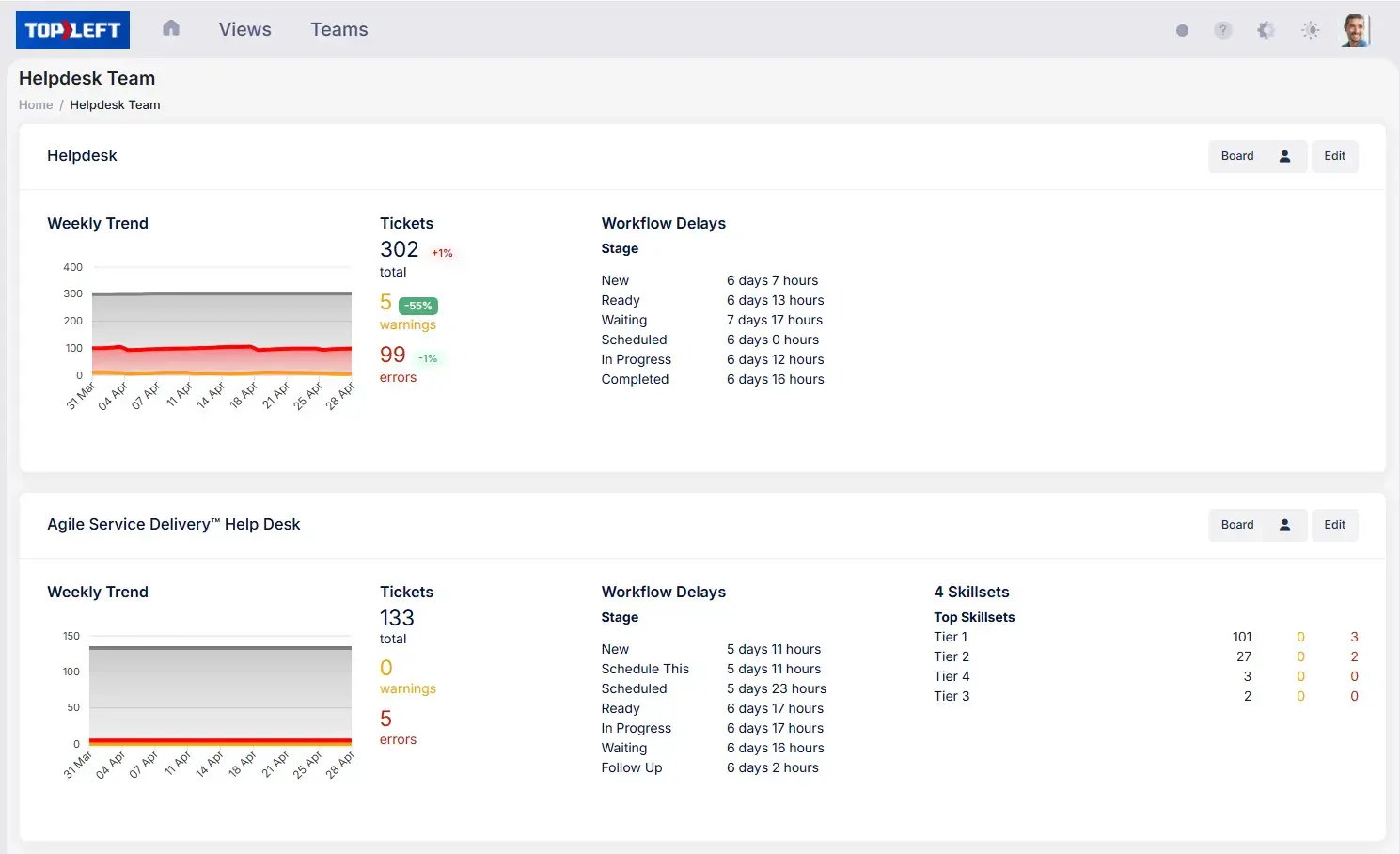
But what happens when you try to have it both ways?
A Costly Mixed Approach Experiment
A past client learned this lesson painfully. This 30-person MSP was struggling with project visibility, managing 40-60 concurrent projects while maintaining service delivery standards. Their traditional PSA tools provided zero portfolio oversight.
“We couldn’t see everything,” the senior leader recalls. “Projects were slipping, resources were overallocated, and we were constantly firefighting.”
The Initial Success
The MSP implemented TopLeft’s visual tools for their project managers:
-
Priority-based visual boards
-
Timeline management charts
-
Weekly planning sessions with cross-functional input (from every role involved, service desk and projects alike)
Initial results impressed everyone. Weekly project reviews became data-driven, project visibility improved by 75%, and workflow conflicts dropped by 40%.
The Fatal Operational Mistake
Then they tried running a “mixed approach” without proper coordination:
-
Project managers used TopLeft’s visual tools
-
Technicians continued working through traditional ConnectWise dispatch
-
Service tickets stayed in conventional queue management
-
No unified workflow existed to guide continuous improvement
“You can’t be a little bit pregnant,” the leader now reflects. “The mixed approach without strong integration is dangerous for operational efficiency.”
The Role-by-Role Breakdown
Technicians became confused:
-
Half their assignments came through traditional calendar scheduling
-
The other half came through visual boards with different prioritization
-
They never knew which system contained actual priorities or SLA-critical work
Service managers felt excluded:
-
Service delivery ran without a current view of technician workload
-
Resentment grew that visual tools seemed “just for project work”
-
Meanwhile, project managers had beautiful portfolio dashboards they couldn’t share
Coordinators lost control:
-
Service coordinators couldn’t see project allocations when managing ticket queues
-
Double-booking increased significantly
-
Workflow conflicts became constant without cross-functional teams
Communication broke down:
-
Project status updates in visual tools missed service teams
-
Critical information fell through the cracks daily
-
Clients received mixed messages about their IT partnership
The Expensive Result
Leadership abandoned TopLeft entirely and switched to an expensive alternative that cost significantly more, believing a different platform would solve their adoption challenges.
The real tragedy? Their problems weren’t with TopLeft’s capabilities. They were incomplete implementation and missing the fundamental mindset shift needed to truly optimize their processes.
So how do you avoid this fate?
The Framework: How to Roll Out Kanban Without Overwhelming Your Team
Here’s the critical distinction: Phased implementation (effective) vs Partial implementation (worthless).
-
Phased means everyone eventually embraces the full system
-
Partial means some never do
-
One builds momentum through continuous improvement
-
The other guarantees abandonment
Phase 1: Pilot Team Success (Months 1-2)
Start with a complete cross-functional team that proves the system works
Build your pilot:
-
1 PM seeking better project lifecycle management, and an easy visual of where they need to intervine
-
2-3 technicians wanting clarity on what tickets they should be doing next
-
1 coordinator tired of clicking buttons in the Dispatch Portal to constantly rework people’s calendars
This team commits fully:
-
Kanban boards for every ticket and project (no exceptions)
-
10-minute regular huddles that energize the team regularly and keep them on track
-
Weekly retrospectives that turn bottlenecks into flow improvements
-
Document wins to build momentum
Change Management Key: Lead by example. Share the visuals in all meetings, and screenshots on Teams. Select volunteers eager for improvement. Provide coaching. Let them customize workflows. They become your transformation advocates.
Phase 2: Controlled Expansion (Months 3-6)
Spread proven practices throughout your organization
Add one complete team per month:
-
Pilot team members mentor new adopters (peer influence beats mandates)
-
Always add complete teams, never just roles
-
Customize the Kanban to meet that team’s needs and to avoid clutter
-
Keep existing workflows as backup until new habits solidify
-
Share wins frequently
Momentum Builders:
-
“Look what the pilot team accomplished!” beats “You must use this”
-
One new habit at a time prevents overwhelm
-
Public celebration of reduced resolution times creates interest
-
Address resistance in retrospectives, not confrontations
Phase 3: Organization-Wide Flow (Months 6-12+)
Scale your MSP’s operational efficiency
Now you expand proven practices:
-
Customize based on pilot discoveries
-
Habits matter more than perfect board configurations
-
Track metrics that show real improvement
-
Make continuous improvement a habit
The Non-Negotiables for Success:
-
Technicians must pull work from Kanban boards (or nothing changes)
-
Managers must embrace flow over traditional scheduling (or confusion persists)
But wait, what about the common objections?
The Myth: “We’ll Start Small and See How It Goes”
This sounds prudent. It sounds like risk management.
It’s actually guaranteeing failure.
Here’s what “starting small” really looks like:
-
No daily habits form: old ticket chaos continues
-
No KPIs improve: enthusiasm evaporates
-
Team shrugs: “Guess it doesn’t work for our workflows”
The Truth About Team Capacity
“But my team can’t handle this much change!”
Consider this. Your team already handles:
-
Constant escalations and shifting priorities hourly
-
Unclear task dependencies and frustrated clients daily
They’re already overwhelmed by poor workflow management. You’re not adding burden. You’re replacing chaos with visual clarity.
The solution? Start with volunteers, provide weekly coaching, and celebrate wins publicly. Focus on incremental improvement because perfection kills momentum.
Review: Your Choice Is Surface or System?
Time for clarity. You have exactly two options:
Option 1: Partial Implementation (The Path to Nothing)
-
Some roles try Kanban boards
-
Technicians stay buried in ticket queues
-
Zero habits change, zero metrics improve
-
6 months later: “TopLeft didn’t work for us”
-
Result: Wasted time, damaged credibility, back to inefficient workflows
Option 2: Phased Full Implementation (The Path to Operational Excellence)
-
Start with complete pilot teams proving the system
-
Expand systematically until everyone’s using visual management
-
Build habits that compound into efficiency gains
-
9-24 months later: 20-25% EBITDA margins
-
Result: A workflow system your competitors can’t match
The difference isn’t implementation speed. It’s about completing the journey.
Success demands these essentials:
-
Every technician pulling from Kanban boards (not calendars)
-
Daily huddles becoming routine as morning coffee
-
Weekly retrospectives (regular meetings where the team agrees what to change) turning bottlenecks into improvements
-
Leadership demonstrating the new workflows daily

Bottom Line
Testing TopLeft doesn’t hurt, but it doesn’t help either. Only implementing the full system of mindset, methodology, and habits creates the compound effect that transforms MSPs from reactive to proactive operations.
At the end of the day, your choice is to either stay with your current system’s known limitations or commit to a complete transformation long-term that unlocks your MSP’s true potential. There is no successful middle ground.