
PSA Integration
TopLeftTwo-way sync with ConnectWise, Autotask, and HaloPSA for both service tickets and projects
MoovilaTwo-way, project-focused, with Smart Schedule layering ticket and calendar data on top
TopLeft vs Moovila
Moovila is built for project portfolio scheduling. The RPAX engine handles critical path scheduling on its own, throws up flags when a project's at risk, and works out your resource needs ahead of time. Good at that, no argument. What it won't do is help the tech who's staring at a queue at 2pm wondering what to grab next. There's no board your techs work from every day. No real-time capacity view your service manager can act on without checking three places first. And onboarding? It flips the tool on. It doesn't change the way the team actually works.
Run it next to ConnectWise, Autotask, or HaloPSA and you'll bump into a few problems pretty fast. No board for the techs means the service desk is still living inside the PSA queue. Smart Schedule can see the tickets, sure. But it won't let your techs actually work them. And here's the catch with that AI layer: your team sits around waiting for the system to announce what's next, when they could just be looking at it themselves.
That friction stalls adoption. When your team doesn't trust the logic driving the schedule, people drift back to the PSA. You've heard this before. "Nobody was using it."
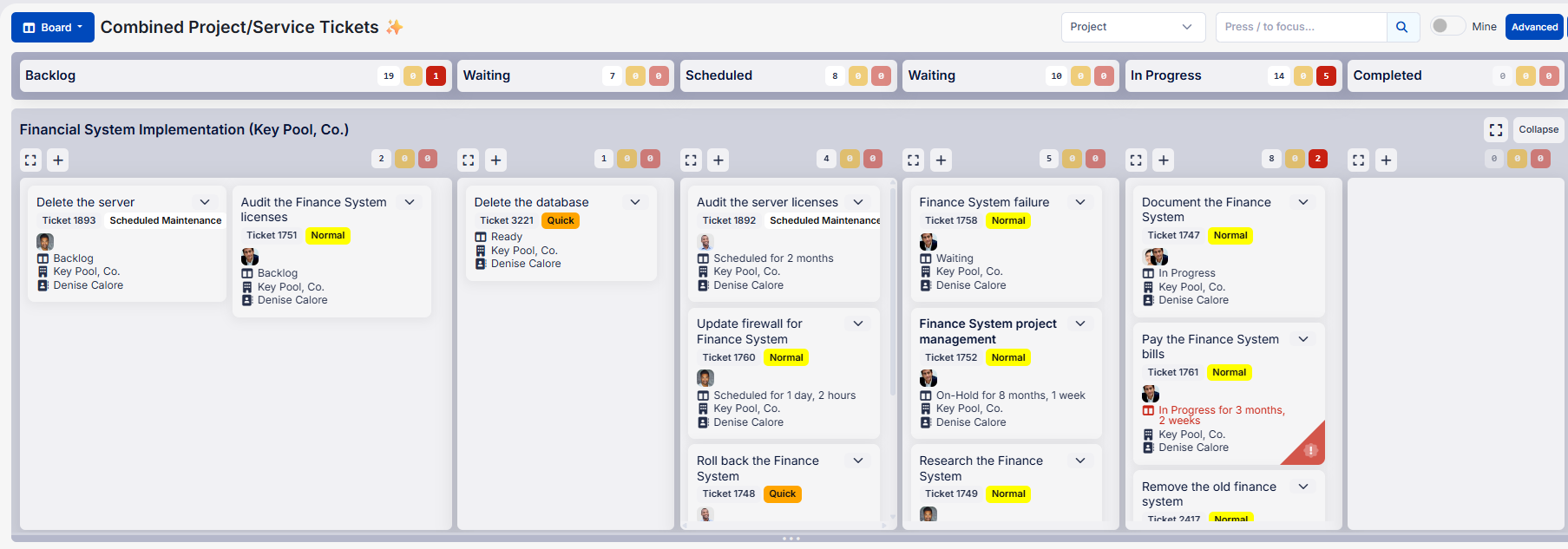
TopLeft is built for MSPs, by an MSP. Wim Kerkhoff has run MSPs for 18 years, and both of his companies use TopLeft daily. Here's what you get: Kanban boards that pull everything together and sync to your PSA, capacity planning that shows you in real time when the next project can actually start, and onboarding that comes as coaching, sized to your team and the way you work.
Side by side
| Features | TopLeft | Moovila |
|---|---|---|
| PSA Integration | Two-way sync with ConnectWise, Autotask, and HaloPSA for both service tickets and projects | Two-way, project-focused, with Smart Schedule layering ticket and calendar data on top |
| Service Ticket + Project Visibility | One Kanban board showing every service ticket and project task your team works from each day | Smart Schedule pulls ticket data in for scheduling, but techs get no daily board to work those tickets from |
| Onboarding as Coaching | Programs matched to where your team actually is: Launch (under 10), Optimize (10+), Accelerator peer coaching, and Discovery Project diagnostics led by Wim | Customer Success-led onboarding, not split out by team size or how you work |
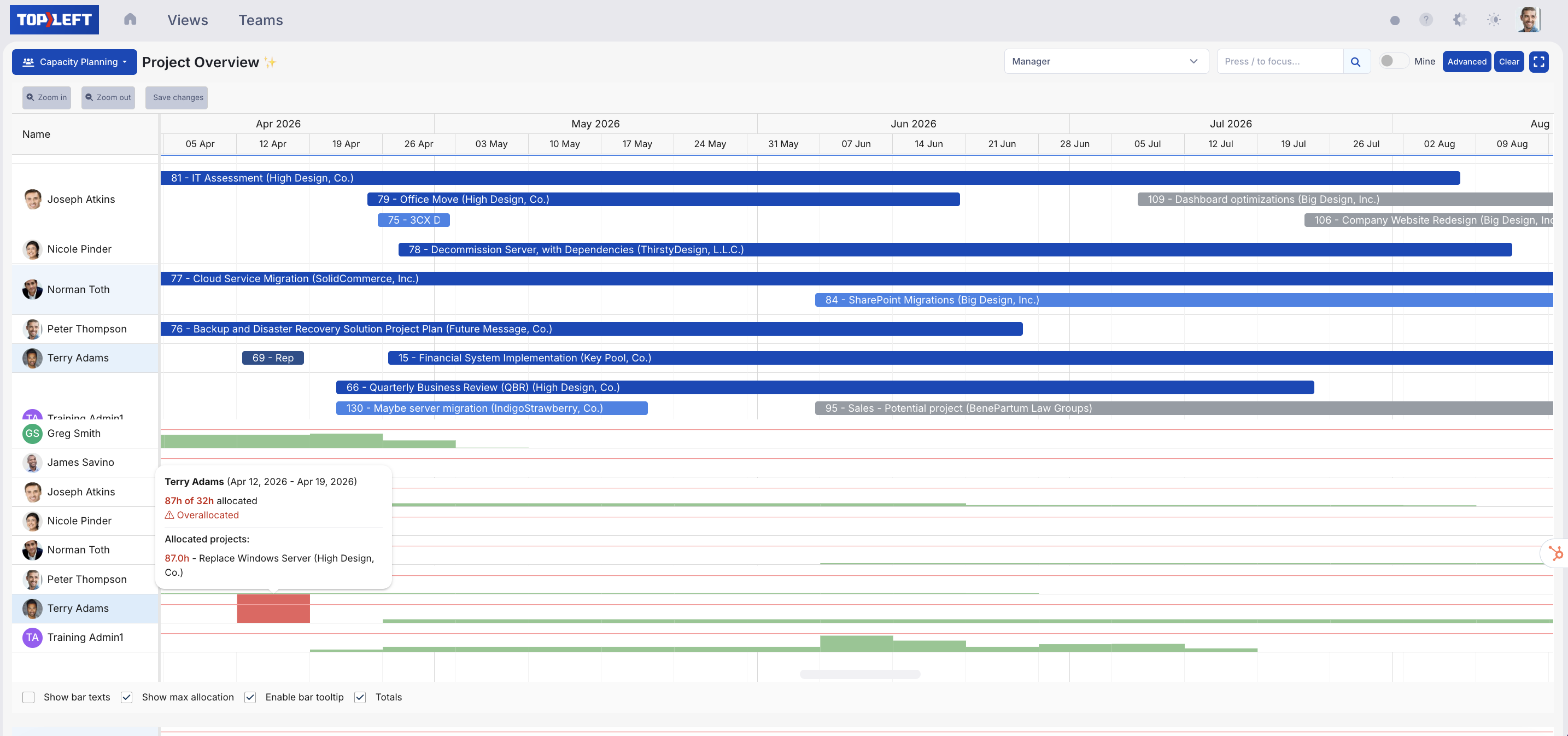
| Capacity Planning | Real-time heatmaps stack each engineer's assigned hours against available hours, with drag-to-test scheduling before anything commits to the PSA | Resource management dashboard plus Smart Schedule with AI-driven critical path automation |
| Client Portal | Native portal where clients see ticket and project status without PSA access | Not included |
| Drag-and-Drop Workflow | Drag tickets between technicians, statuses, and priorities with instant PSA sync | No daily Kanban board, no Dispatch View, no WIP limits |
| Time Entry | Log time right from a Kanban card, syncs straight to your PSA for billing | Time entry built into work tickets via PSA integration |
| Implementation | Launch runs a focused few weeks with coaching from a dedicated onboarding lead. Optimize runs longer with per-team deep dives and 30/90-day check-ins | Onboarding led by Customer Success, not segmented by team size |
| Pricing Model | Per-user pricing with MSP features included, paid pilot available | Paid pilot available |
| Target User | MSP technicians, coordinators, project managers, and service managers running client work end to end | PMOs and project planners running multi-phase portfolios with heavy dependency mapping |
Getting started
Honest fit
Your technicians are spread across service tickets and project tasks. Nobody can see who's working on what. One senior engineer is buried while two others wait for assignments, and tickets are going unlogged because the PSA queue is hard to read. You've probably got jobs a tech started four or five days ago that haven't moved since.
With TopLeft, every ticket and every project task lands on one board, and it syncs both directions with ConnectWise, Autotask, or HaloPSA. Techs grab their next priority themselves. No waiting for someone to hand it over. And a service manager catches an overload in seconds, instead of finding out the hard way when an SLA slips.
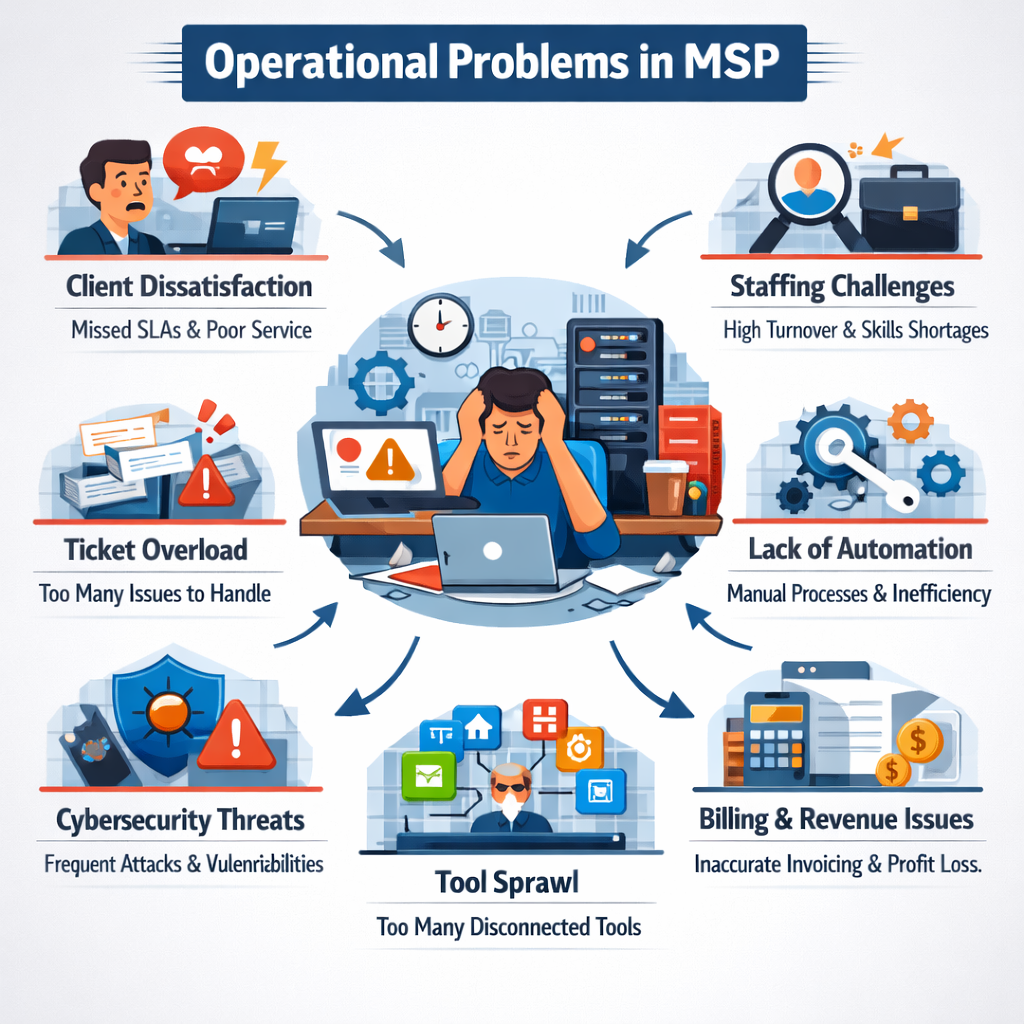
Picture a client asking you right now when their project can kick off. If your honest answer is "not sure, let me check a few places," well, that's your capacity planning problem right there. You wind up committing to work before you know who's even free, because getting the answer means doing mental math across three different tools. One owner told us he had 12 projects open when one or two was the right number.
The capacity view lines up each engineer's committed hours against what's actually available, twelve weeks out, with vacation, training, and meetings already baked in. Drag projects around to test a schedule before anything commits to the PSA. And since onboarding is coaching built around your team size and how you work, the methodology actually sticks instead of falling apart by week three.
Fair question. The Launch program was made for teams under 10, and the math holds up just fine down there. No more nightly ritual of staring at the service desk board, trying to work out why nothing's moving. No dispatcher exporting to Excel. Just your handful of techs pulling the right work in the right order. Fifty people isn't the threshold for the visibility to pay for itself.
Say your PMO owns multi-phase deployments, the kind with heavy dependency mapping. You want AI-driven critical path automation, risk monitoring around the clock, and a way to model "what if we land this deal" against the sales pipeline. Your service desk runs on its own separate tool, and that's perfectly fine.
Moovila brings real scheduling smarts and deep resource forecasting to the table when your big headache is the project portfolio itself, not the daily mix of service and project work.

Your people are fine handing it over to the AI: letting it flag conflicts, suggest fixes, and reforecast timelines on its own. RPAX hums along in the background and you trust what it's telling you.
But here's the thing. Wiring Moovila into your daily service desk still calls for a separate Kanban or workflow tool, so the double-entry headache sticks around. It just moves. Moovila was built for the planner and the PMO, not the engineer in the thick of their day.

Proof
Steve over at TEBA cut his project delivery time by 58.4% in six months. That's no tooling trick. It's what you get when work stops sitting unseen between people.
And Scott at Allixo? He took his margin from 9% up past 22%, pulled two dispatchers off what he called "Calendar Tetris," and clawed back something like 80 hours a week. His client retention has sat at 100% for two years straight now.
Chase at Appalachian dragged SLA compliance from 60% up past 90%. Seitel Systems? They went from a 300-ticket backlog down to fewer than 15. These are MSPs that already had a PSA. What they didn't have was a board the whole team could work from.
Get a personal tour of how PSA-integrated Kanban boards, real-time capacity planning, and hands-on onboarding give your team a shared view of all their work. See how the Dispatch View stops the constant interruptions.